


Why discovery matters more than ever in AI-assisted product development


AI has prompted conversations that didn't previously exist during the discovery period for designing and building a brand new digital product.
I recently completed a five-week discovery period ahead of designing and building a brand new digital product.
At the beginning of any project, your understanding is at its lowest. You don't yet fully understand your users, your constraints, your opportunities or even the assumptions you're making. Discovery isn't where certainty exists. It's where certainty starts to emerge.
Like most discovery phases, we had some big questions to answer before committing to the build of a brand new digital product. Were we solving the right problem? Did we understand our users? Were our technical assumptions sound? Had we really discovered the project we were about to embark on?
One of those topics was, perhaps unsurprisingly, AI.
Being an AI-assisted project, it naturally became part of our discovery too. Not in the sense of asking whether we should use AI, but how. Which tools were appropriate? Which parts of the process should they support? Where could they genuinely help us move faster, and where was human judgement still essential? Before long, we realised we weren't just discovering the product. We were discovering how we wanted to build it.
It reinforced something I'd believed all along, despite much of the current conversation suggesting otherwise: as product teams become faster at realising ideas, discovery becomes more important, not less.
Discovering people
Most product discussions begin with functionality. Discovery allows them to begin with context.
A product brief might tell you that a user needs to submit an item, upload photos or create an account. Discovery asks a different set of questions. Where are they when they're doing this? Are they rushing between meetings? Sitting on a train with an unreliable signal? Picking up their phone for thirty seconds before boarding a flight? Does this step feel natural, or are we asking too much too soon?
Those questions rarely appear in a product flow, but they're often the difference between a product that works on paper and one that works in someone's life.
For me, this is where design creates the most value. Not by arranging screens, but by understanding the context around them. The earlier those conversations happen, the fewer assumptions make their way into production and the easier it becomes to align everyone around the reality of the user, rather than an idealised version of them.

Discovering possibilities
Discovery isn't just about validating an idea. It's also about exploring the consequences of the decisions we make before a single line of production code is written.
One of our biggest discussions centred around whether the app should be built natively across platforms or using React Native. At first glance, it sounds like a technical decision. In reality, it quickly became a conversation about product and design too.
We explored different approaches by rapidly wireframing the same journeys through both iOS and Android conventions. What started as a discussion about technology soon became a discussion about behaviour. What were we actually optimising for? Platform familiarity? Development speed? Long-term flexibility? Most importantly, what genuinely created the best experience for the person using the product?
We kept coming back to the same question: are we serving the platform, or the user?
The answer wasn't to ignore platform conventions. It was to remember why they exist in the first place—to make the experience feel intuitive for the person holding the phone.
Discovering ourselves
Perhaps the biggest surprise was that we weren't just discovering the product. We were discovering ourselves as a team.
AI prompted conversations that simply wouldn't have existed a couple of years ago. We questioned ownership, fidelity, collaboration and even the shape of our design process. What should designers spend time on? What could engineering move forward with? Where could AI genuinely accelerate us? How much fidelity did we actually need before something became valuable?
Those weren't side conversations. They became an important part of discovery because understanding how a team is going to build something is just as important as understanding what they're building.
One thing we all noticed, designers and engineers alike, was just how exciting it became to see ideas realised so quickly. We produced a working UI faster than on any project I'd experienced before. That wasn't threatening. It was genuinely energising. Seeing ideas come to life earlier gave us something tangible to react to, challenge and improve together.
But we also realised something important.
AI wasn't replacing the work that came before those first interfaces. If anything, it made that work even more valuable.
The leap from an initial idea to a meaningful first-pass UX still depended on contextual thinking, years of experience, an understanding of user behaviour, client goals and technical constraints, and the human judgement to balance all of those things. AI could help us visualise the outcome much faster, but it couldn't replace the thinking that made that outcome worth visualising in the first place.
That, I think, was our biggest discovery.
The value of design was never in producing screens. It was in making sure those screens were built on the right understanding.
What discovery enables
My biggest takeaway from this project wasn't that AI changes discovery. It was that it changes what discovery enables.
We can now bring ideas to life earlier than ever before, making assumptions visible while they're still easy to challenge. That's incredibly exciting, because it allows teams to have richer conversations and make better decisions much earlier in the process.
But faster tools don't reduce the need for discovery—they increase the value of getting it right.
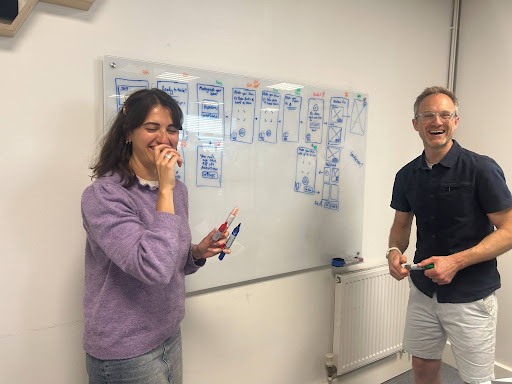
Perhaps that's why discovery remains my favourite part of any project. There is nothing quite like taking an idea, throwing it onto a whiteboard, pulling it apart, rebuilding it, challenging it and occasionally abandoning it altogether before landing on something stronger. It's messy, collaborative and rarely linear, but it's also where the most valuable product thinking happens.
The tools we use to realise ideas will continue to evolve. Discovery is what gives us confidence that we're realising the right ones.
Looking for something else?
Search over 450 blog posts from our team
Want to hear more?
Subscribe to our monthly digest of blogs to stay in the loop and come with us on our journey to make things better!
